Understand TLS/HTTPS with Diagrams and Exercises
"A certificate error appeared, and I can't tell whether it's safe to ignore." "Can I really tell a customer that the padlock means the site is safe?" — We use HTTPS every day, yet what happens inside is surprisingly hard to explain. Instead of memorizing TLS, this course aims to let you follow what happens behind the padlock through three questions: is the peer genuine, is the content secret, and has it been tampered with. You grasp the big picture with diagrams, then check yourself with short exercises and hand calculations placed right after each section.
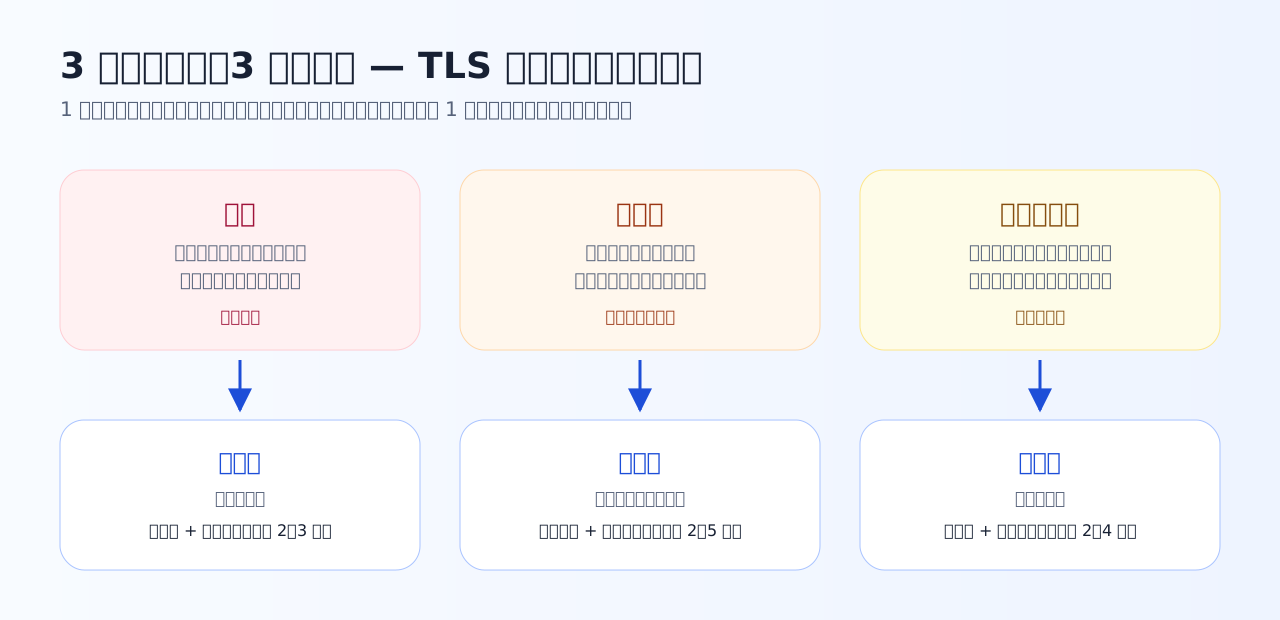
TLS is not a single piece of magic but a combination of tools, each answering a different threat. Keep this mapping in mind and every later chapter becomes easier to read. (Diagrams are shared with the Japanese course.)
What makes this course different
The three questions that run through this course
Whenever you look at an HTTPS connection or a certificate error, this course returns to the same three questions. As the chapters progress, you gain one tool after another for answering them.
The course motto: when you see a padlock or a certificate error, don't stop there — ask: what is missing right now — the peer check, the secrecy, or the tamper detection?
Chapters
How to take this course
- Go in the order text → the quiz right below it. Answering immediately after reading beats saving questions for later.
- Don't do the Chapter 3 calculations in your head — write out the powers and the mod steps on paper. The feel of "what the eavesdropper sees and cannot see" comes through your hands.
- Try the Chapter 3 simulator both before and after the quiz. The numbers turn into intuition.
- If a Chapter 7 case stumps you, go back to the matching chapter for a quick review. No need to redo everything.
Prerequisites
- Having used websites or apps is enough. Server-operations experience is not required.
- If you can compute powers (23 = 8) and remainders, you can handle the hand calculations in Chapter 3.
- No deep cryptography theory. We stay at the level of "what problem does this tool solve" and never enter the mathematics of RSA or elliptic curves.