Sex-linked, mitochondrial, and chromosomal inheritance
Distinguish non-autosomal inheritance patterns, and tell sequence-level variation apart from chromosomal changes.
Words used in this chapter
Viewpoint used in this chapter
Of the five viewpoints listed on the course top page, this chapter focuses on "3. Separate the inheritance patterns." We organize autosomal, X-linked, mitochondrial, and de novo cases without mixing them up.
This chapter uses the textbook XX/XY model
In this chapter, we use the XX/XY model that school textbooks commonly rely on to grasp the basics of X-linked inheritance. Real-world sex is more diverse than this, but we start with a simplification in order to learn how inheritance patterns work. Each problem and figure assumes this XX/XY framing — please re-anchor on that whenever you read them.
For X-linked traits, a father does not pass X to his son
The most important point in X-linked problems is that a father passes X to his daughter and Y to his son (under the XX/XY model). Imagining this the other way around throws the reading of the family tree into confusion.
That is why, in introductory X-linked problems, you first confirm "is the child we are looking at a son or a daughter?". Even for the same parental combination, the probability for sons only is not necessarily the same as the probability for daughters only.
Mitochondrial DNA is usually followed through the maternal line
Mitochondria carry their own DNA. At an introductory level, it is easier to organize things as normally passed from mother to child.
In other words, when tracing a family, you look first at the maternal connections. "Not normally passed from the father" is the basic rule of this chapter.
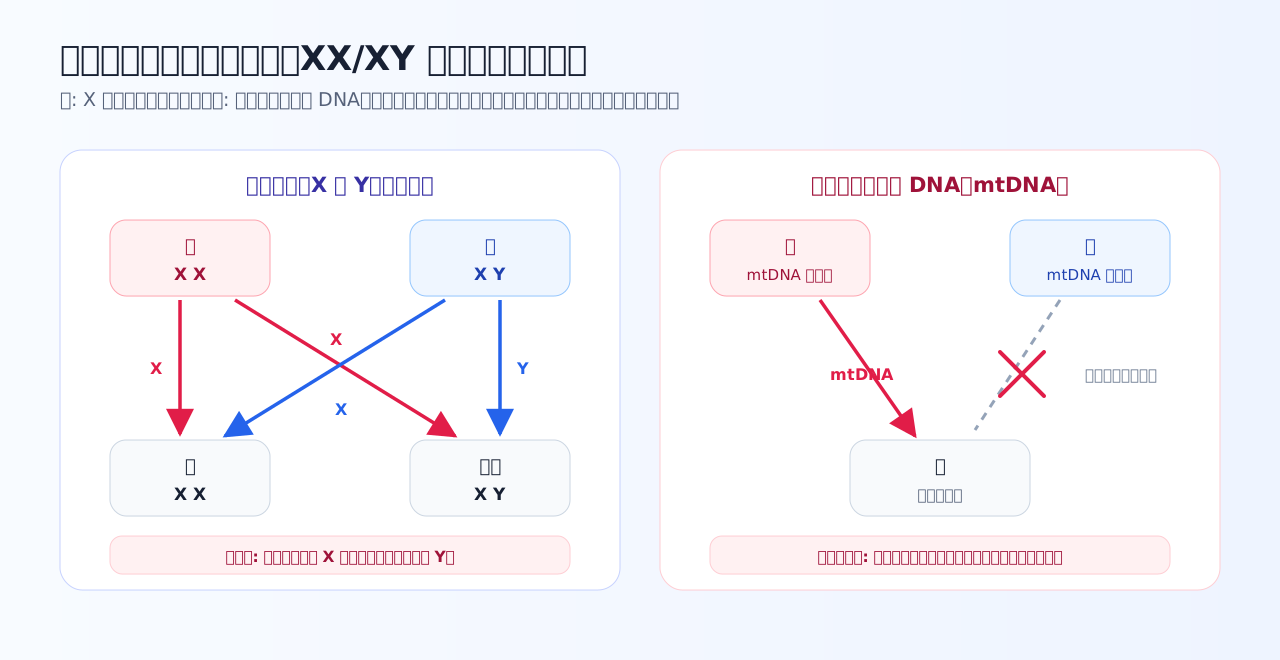
Left: how X and Y are passed in the textbook XX/XY model — a father never passes X to a son. Right: mtDNA — trace the maternal line first. Memorizing these two pictures is the shortcut for this chapter. (Diagram labels are in Japanese; the layout follows the surrounding text.)
Check 1 — X-linked traits and mitochondria
Confirm how traits travel in the XX/XY model, and how mtDNA follows the maternal line.
Q1. In an introductory X-linked recessive model, the mother is a carrier X^A X^a and the father is X^A Y. What is the probability that a child is affected, given that the child is a son?
A son receives Y from his father and X from his mother.
With this combination, a son becomes either X^A Y or X^a Y depending on which X he receives from his mother, so among sons the probability of being affected is 50%.
Q2. In the textbook XX/XY model, which of the following is closest to how a father passes sex chromosomes to his children?
A father passes X to his daughter and Y to his son.
In the introductory model, the father passes X to his daughter and Y to his son. That is why, for X-linked traits, you do not think of it as 'the father passes X to his son.'
Q3. Which is the closest introductory description of how mitochondrial DNA (mtDNA) is inherited?
Normally the maternal side is the one passing it to the next generation.
Mitochondrial DNA is normally passed through mitochondria that come from the egg, so at an introductory level we describe it as passed through the maternal line.
Even without family precedent, genetic factors can still be involved
When you cannot find anyone with the same disease in the family tree, it is easy to assume "this is not genetic." But, as with de novo variants, a change can first arise within the family.
Concrete examples: a substantial fraction of severe intellectual disability and developmental conditions, certain childhood cancers, and skeletal disorders such as achondroplasia are known to be caused by variants that newly arose in the child even though neither parent has the same condition. The exact frequency depends on the variant, but at the introductory level it is enough to remember: "a disease with no family precedent does not necessarily have zero genetic contribution."
So, "no precedent" does not mean "zero genetic contribution". The family tree is a huge clue, but it is not all-powerful.
Sequence changes and chromosomal changes are on different layers
Genetic stories involve at least two layers.
Even for the same "genetic change," whether the sequence of letters changed or whether the number of chromosomes changed determines which layer you are looking at.
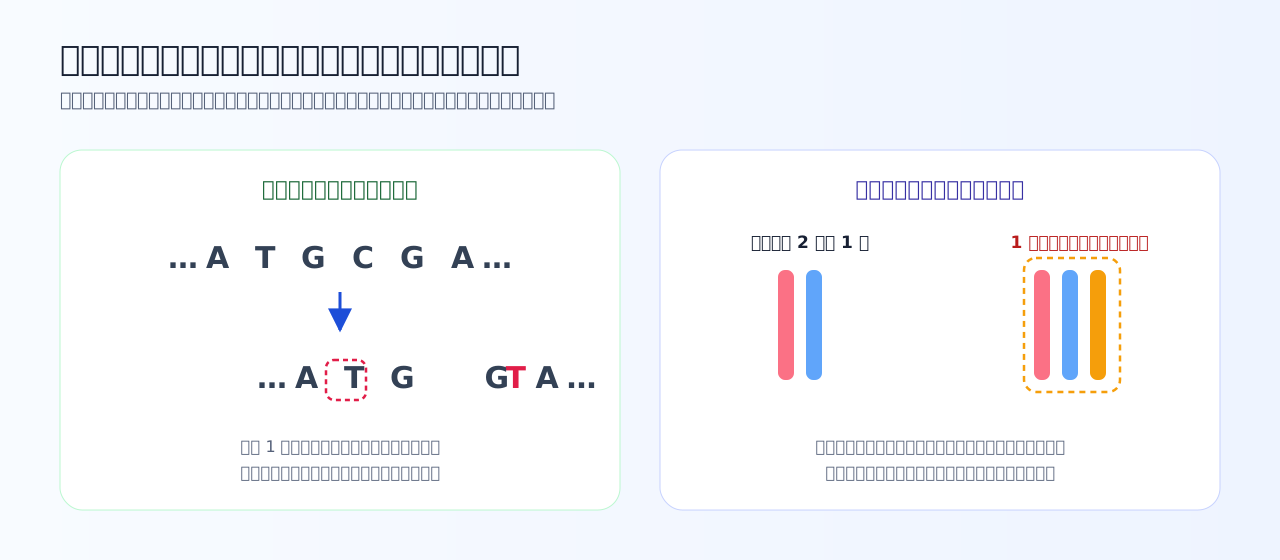
Left: a sequence-level change (one letter in the string). Right: a chromosome-level change (one extra copy, as in a trisomy). The same word "change" — but a completely different zoom level. (Diagram labels are in Japanese; the layout follows the surrounding text.)
Switch between inheritance patterns and compare
Common misconceptions: Do not think of the father as passing X to his son — he passes Y. "No precedent in the family tree" does not mean "no genetic factor at all." A single-base change and a change in chromosome number are not the same thing.
Check 2 — De novo variants and chromosome-level changes
Separate sequence-level changes from chromosome-level changes, and consider genetic factors with no family precedent.
Q4. Which is the closest description of a de novo variant?
It can occur even with no precedent in the family tree.
A de novo variant is a variant that newly arose in that family. It is not necessarily inherited from the parents.
Q5. Which is the closest example of a 'change in chromosome number'?
Look at the count of entire chromosomes, not at single-base changes.
A change in chromosome number is not a change in a single base but a change in the total count of whole chromosomes.
Q6. Even when there is no family-tree precedent of the same disease, genetic factors can still be involved. Which description is closest?
'No precedent' does not equal 'not genetic.'
Even when the family history does not stand out, genetic factors can still be involved through de novo variants, differences in penetrance, and so on.
Key takeaways from this chapter
- For X-linked traits, think of the father as passing X to his daughter and Y to his son.
- For introductory purposes, follow mtDNA along the maternal line.
- Even without precedent, genetic factors can still be involved through de novo variants and similar.
- Treat sequence-level changes and chromosome-level changes as living on different layers.