Mendelian inheritance — reading dominant, recessive, and carriers as probabilities
Use the Punnett square to organize dominant, recessive, carriers, and per-pregnancy probabilities.
Words we use in this chapter
Viewpoint used in this chapter
Of the five viewpoints listed on the course top page, this chapter focuses on "3. Separate the inheritance patterns" and "4. Check what the probability is conditional on." The goal is to read autosomal dominant and recessive patterns through a Punnett square and to keep per-pregnancy probabilities and conditional probabilities cleanly separated.
Dominant and recessive are not "strong vs. weak"
The dominant and recessive that show up in genetics have different meanings from the everyday "superior" and "inferior."
In this chapter, for clarity, A and a are just labels. A does not mean "good" and a does not mean "bad."
A Punnett square keeps the probabilities visible
From parent to child, one allele is passed per locus. So if you write out which alleles each of the two parents can contribute, and drop them into a 4-cell Punnett square, the combinations become easy to see.
For example, for A/a × A/a, the child outcomes are AA, Aa, Aa, aa — four possibilities. Because the four sit side-by-side with equal probability, you can read off a/a as 1/4 and A/a as 2/4.
The "dominant / recessive" labels here are an introductory-model way to split how the phenotype shows up. They do not mean strong / weak or good / bad.
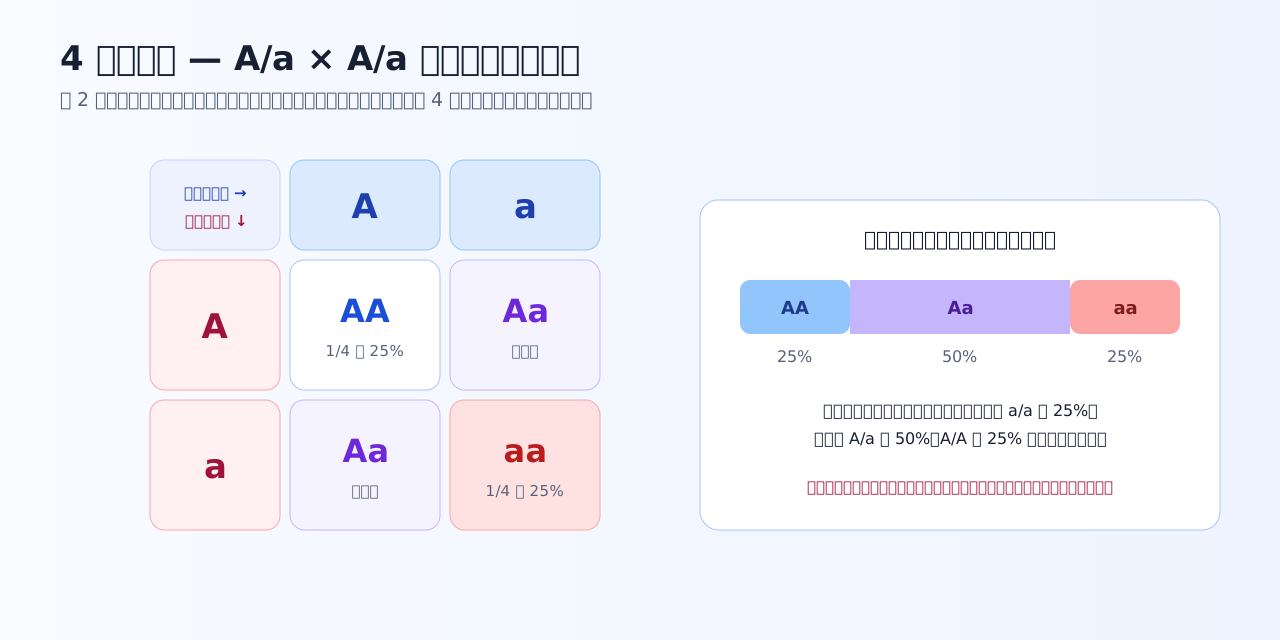
The Punnett square for A/a × A/a. The four cells are equally likely, so the ratios can be read straight off the table — draw this shape before answering the probability questions. (Diagram labels are in Japanese; the layout follows the surrounding text.)
Check 1 — Read the ratios from a Punnett square
For each parental pairing, organize the proportions of child genotypes in a four-cell table.
Q1. In the introductory autosomal recessive model, when both parents are carriers A/a, what is the probability that a child is a/a?
Write out the 4-cell table — you get AA, Aa, Aa, aa.
In A/a × A/a, of the four outcomes only one is a/a, so the probability is 25%.
Q2. In the introductory autosomal recessive model, when one parent is a carrier A/a and the other is a/a, what is the probability that a child is a/a?
Try writing out A/a × a/a in a 4-cell table.
A/a × a/a gives Aa, aa, Aa, aa, so a/a is 2/4, i.e. 50%.
Q3. In the introductory autosomal dominant model, when one parent is A/a and the other is a/a, what percentage of the children receive A?
Gametes from the A/a parent are half A and half a.
A/a × a/a yields A/a and a/a in equal proportions, so 50% of children receive A.
Carriers and per-pregnancy probability
The word carrier shifts slightly depending on context, but at the introductory level it is easiest to think of as "someone who has one copy of a variant involved in disease and can pass it on to the next generation."
Another very important idea here is per-pregnancy probability. The Punnett square for the next child is not automatically rewritten by what happened with the previous child — just like with coin flips, the fact that heads came up before does not make tails more likely next time.
"Given what we now know" — conditional probabilities
Stepping up a little, readings like "given that the child is not a/a" come up as conditional probabilities. In those cases, you take the original four outcomes and remove the ones that are ruled out.
For example, for A/a × A/a, if a child is known not to be a/a, the remaining outcomes are AA, Aa, Aa — three possibilities. Of those, two are carriers A/a, so the answer is 2/3.
Common misconception: Dominant does not mean "a superior trait," and recessive does not mean "an inferior trait." The probability for the next child is not "balanced out" by the results of previous children. The word "carrier" is not always used with exactly the same meaning — look at context first.
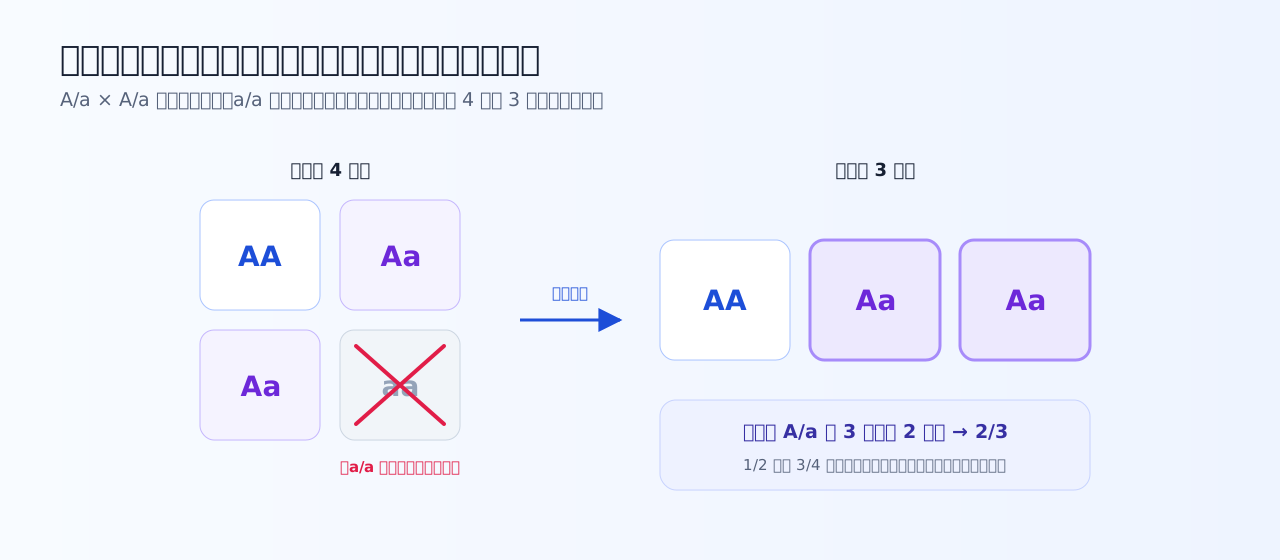
Once you know the child is not a/a, cross out the impossible cell and recount: the denominator drops from 4 to 3, so the probability of being a carrier A/a is 2/3. (Diagram labels are in Japanese; the layout follows the surrounding text.)
Check 2 — Carriers and conditional probability
Pin down what "carrier" means, the independence of each pregnancy, and how to read conditional probabilities.
Q4. Which description is closest to what a "carrier" means in this chapter?
It is easiest to think about this in the autosomal recessive context.
At the introductory level, a carrier is someone who has one copy of a disease-related variant but is typically not affected.
Q5. Which of the following is not a correct way to think about per-pregnancy probability?
An earlier child's outcome does not rewrite how the next round of gametes is built.
For the same parental combination, each pregnancy's probability is computed fresh the same way each time. An earlier child's result does not rewrite the ratios in the next Punnett square.
Q6. For the children of A/a × A/a, given that a child is "not affected a/a," what is the probability that the child is a carrier A/a?
After removing a/a, the remaining outcomes are AA, Aa, and Aa — three in total.
The full set from A/a × A/a is AA, Aa, Aa, aa. Once you know the child is not a/a, the remaining three outcomes are AA, Aa, Aa, so the carrier probability is 2/3.
Key takeaways from this chapter
- Dominant and recessive are labels for how a phenotype shows up.
- Writing the combinations out in a Punnett square keeps you from losing track of the ratios.
- At the introductory level, "carrier" is easiest to think of as "someone with one copy."
- Each pregnancy's probability is computed fresh every time.
- For conditional probabilities, remove the outcomes that are no longer possible and work with what remains.
Bridge to the next chapter
This chapter dealt with "Mendelian inheritance," which can be fully organized in a Punnett square. But not every pattern of inheritance follows this template. Genes on the X chromosome cannot be slotted into the same square as-is, because males and females carry different numbers of X. Mitochondrial DNA is not split half-and-half between the parents; it is normally passed from mother to child. The next chapter organizes these patterns that autosomal Mendelian inheritance alone cannot explain.