DNA, genes, and chromosomes
Learn to talk about DNA, genes, chromosomes, and the genome as distinct units without mixing them up.
Words we use in this chapter
Viewpoint used in this chapter
Of the five viewpoints listed on the course top page, this chapter focuses on "1. Align the units." The goal is to build the habit of saying which of DNA / gene / chromosome / genome you mean, rather than treating them as the same thing.
Line them up with the "instruction manual" analogy
Once you start studying human genetics, DNA, gene, chromosome, and genome come up constantly. The most important thing at this stage is to stop treating all four as the same thing.
As an analogy: DNA is the string of letters, a gene is one section within it, a chromosome is a long sheet rolled up for storage, and the genome is the entire bookshelf. Once this order is in your head, it becomes much easier to think later about "where in the map is this change taking place?"
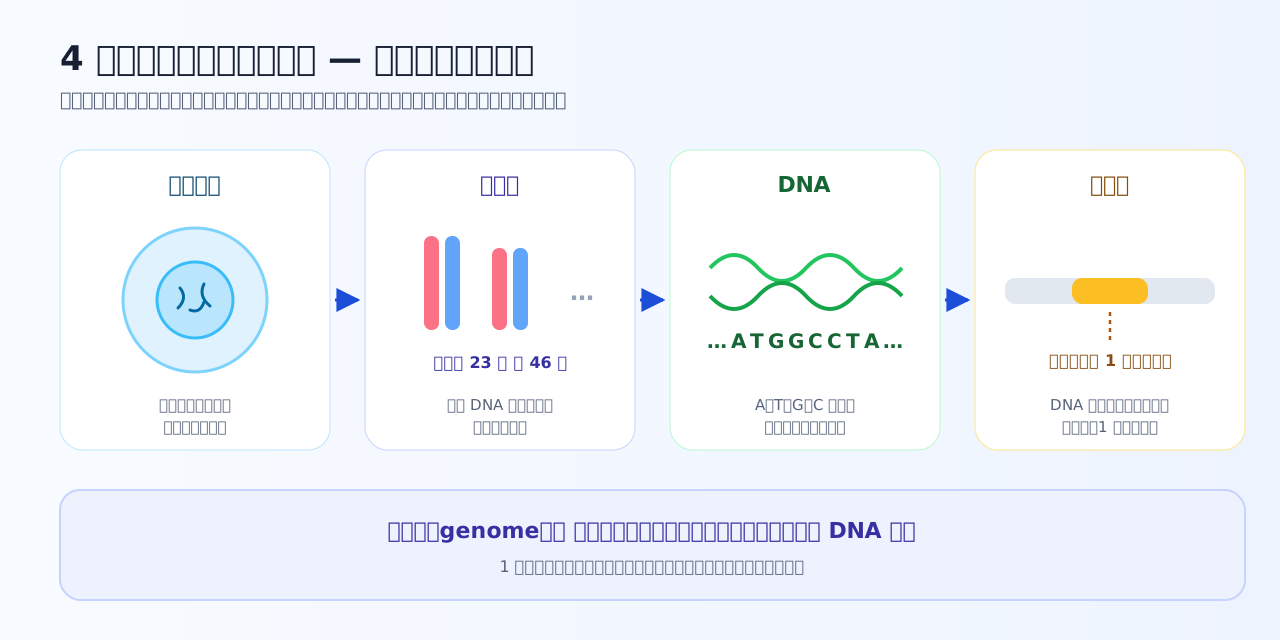
The four units are different zoom levels: chromosomes inside the nucleus, a long DNA string inside each chromosome, a gene as one stretch of that string — and the genome is all of it together. (Diagram labels are in Japanese; the layout follows the surrounding text.)
Human somatic cells: 46 chromosomes, thought of as 23 pairs
At the introductory level, human somatic cells are framed as having 46 chromosomes = 23 pairs. The eggs and sperm that appear later carry half of that count.
What does "pair" mean here? Each pair consists of two chromosomes that carry the same kind of information — one inherited from the mother and one from the father. These two are called homologous chromosomes.
The key point here is that "46 chromosomes" and "23 pairs" say the same thing two different ways — one counts individual chromosomes, the other counts pairs. Once you have "a pair = a homologous pair" in your head, the next chapter's idea that "one of each pair is passed to a gamete" lands smoothly.
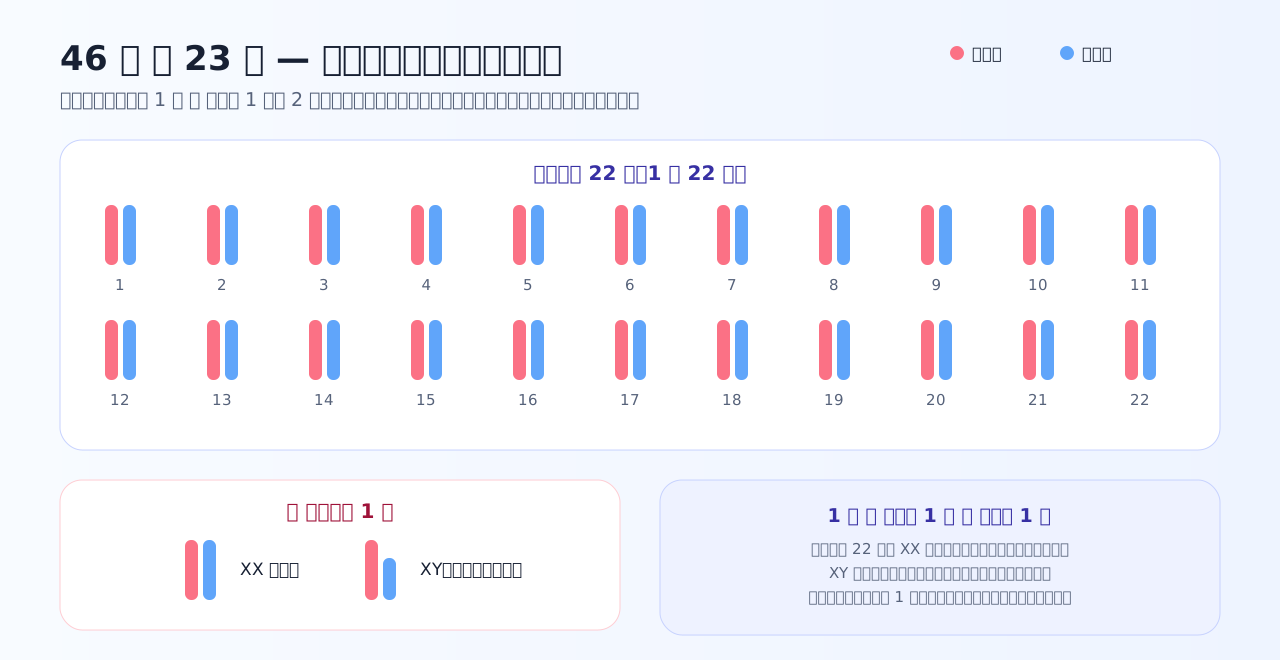
46 chromosomes = 23 pairs in one picture. Every pair is one maternal (rose) plus one paternal (blue) chromosome — the same color coding is reused in the figures throughout this course. (Diagram labels are in Japanese; the layout follows the surrounding text.)
Check 1 — Align the units on the same map
Confirm that you can line up DNA, genes, chromosomes, and the genome on one map and talk about them without mixing them up.
Q1. Which of the following is closest to an introductory description of the relationship between DNA, genes, and chromosomes?
Long DNA is folded into a chromosome, and many genes sit within it.
At an introductory level, it helps to think of DNA as the sequence itself, a gene as a functional stretch within it, and a chromosome as a unit in which long DNA is folded up.
Q2. In the standard textbook introductory model, how many chromosomes in total does a typical human somatic cell have? Enter a number in half-width digits.
23 pairs, 2 chromosomes each.
At the introductory level, human somatic cells have 46 chromosomes organized into 23 pairs. Each "pair" consists of one chromosome from the mother and one from the father — these are homologous chromosomes. There are 22 pairs of autosomes plus 1 pair of sex chromosomes.
Q3. Which description is closest to the word "genome"?
Think of the whole DNA in the cell, not one gene.
The genome is the entire set of DNA instructions a cell or organism carries. Individual genes are parts of the genome.
Genotype and phenotype are not the same thing
Genotype is the genetic combination you carry. Phenotype is the characteristic that can actually be seen or measured.
The two are closely related, but they do not always line up one-to-one. This is an important intuition that connects to later chapters on environment and polygenic traits.
"Variant" is a neutral word meaning "a difference in sequence"
"Mutation" used to be the dominant term, but this course starts with the neutral word variant = a difference in DNA sequence.
The important thing here is that having a variant does not automatically mean disease. Some differences have essentially no effect on health; others are involved in disease. Do not let the word alone jump you to a conclusion.
Common misconception: DNA = gene = chromosome is not correct. They look similar but refer to different units. The word "variant" on its own does not tell you whether a difference is good, bad, or a disease. "46 chromosomes" and "23 pairs" are two ways of saying the same thing about a somatic cell.
Check 2 — Genotype, phenotype, and variants
Separate the design-side from the observed-side, and pin down the neutral meaning of the word "variant."
Q4. Which best matches the correspondence between "genotype" and "phenotype"?
Genotype is the combination on the design side; phenotype is the result that shows up.
Genotype is which alleles you carry; phenotype is the characteristic that actually appears. The mapping between the two is not always one-to-one.
Q5. Which statement about the term "variant" is not correct?
"Variant" is a neutral word for a difference in DNA sequence. Variants can also arise newly.
"Variant" is a neutral label for a difference in DNA sequence. Some variants do not affect health; others do. Variants can also arise newly within a family, so "must always be inherited from a parent" is incorrect.
Key takeaways from this chapter
- DNA, gene, chromosome, and genome are distinct units, not synonyms.
- At the introductory level, human somatic cells are thought of as carrying 46 chromosomes = 23 pairs. A "pair" is a homologous pair — one maternal chromosome plus one paternal chromosome.
- Genotype is on the design-plan side; phenotype is the result that shows up.
- "Variant" is a neutral word that just means "a difference in sequence."
Bridge to the next chapter
So far we have organized the unit "46 chromosomes = 23 homologous pairs." But how do those chromosomes pass from parent to child? In the next chapter we follow the mechanism (meiosis) by which one chromosome from each pair is selected to go into a gamete (egg or sperm). This is the foundation for the "probability of being passed to a child" calculations that appear in later chapters.