Glossary to read first
How to use this glossary: you do not need to read it all at once. Each chapter also has its own short term cards at the top, so it is enough to refer back here only when something feels unfamiliar.
Naphtha
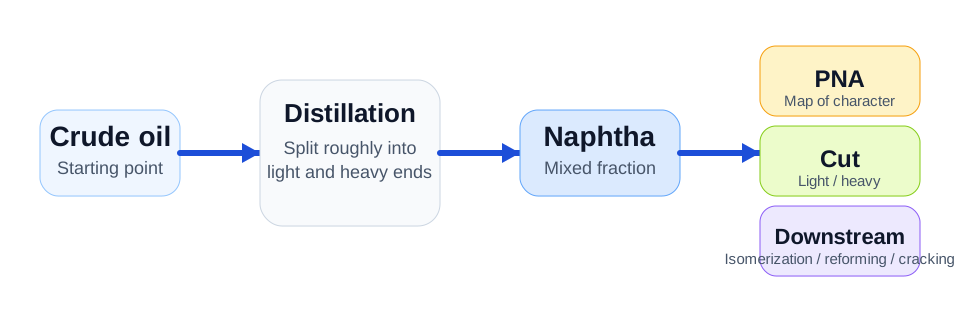
A relatively light mixed hydrocarbon fraction obtained from crude oil or secondary processes. Not the name of a single molecule.
Hydrocarbon
A molecule made mainly of carbon (C) and hydrogen (H).
Fraction
A range of components with similar boiling points, cut out together by distillation.
Pure compound
A substance, like water or hexane, that can be captured by one chemical formula or one kind of molecule.
Carbon number
How many carbon atoms a molecule contains. More carbons generally means heavier.
Saturated
A structure where the carbons are connected mainly by single bonds. Common in paraffins and naphthenes.
Cyclic
A structure where the molecule forms a ring. A ring does not automatically mean aromatic.
Aromatics
Molecules containing a benzene ring. Density and octane tendency tend to run higher.
PNA
Short for Paraffins / Naphthenes / Aromatics — a three-way split for reading naphtha at a glance.
Volatility
How readily a liquid turns into vapour. Lighter components are generally more volatile.
IBP
Initial Boiling Point. The temperature at which distillate first starts coming over.
FBP
Final Boiling Point. The temperature at which the last of the distillate finishes coming over.
Cut
The range, from where to where, that is carved out as a product during distillation.
Hydrotreating
Pretreatment that uses hydrogen to remove sulphur, nitrogen, and other species that would poison downstream catalysts.
Isomerization
Rearranging a molecule's skeleton while keeping its molecular formula unchanged.
Reforming
An operation that pushes heavy naphtha toward higher octane. Aromatics and hydrogen tend to appear as products.
Steam cracking
A high-temperature process that breaks molecules into smaller ones, such as ethylene and propylene.
Octane number
A measure of how resistant a gasoline is to knocking.
SDS
Safety Data Sheet — the document describing properties, hazards, and first-aid measures for handling a substance safely.
Map of this course
There are five viewpoints that we keep reusing throughout the course.
- Think of naphtha as the name of a fraction, not the name of a single molecule.
- As the carbon number grows, compounds generally get heavier, boiling points rise, and volatility drops.
- Looking at PNA gives you a quick read on lightness, density, and octane tendency.
- Move the cut lighter or heavier and the best-fit downstream process shifts with it.
- Do not memorise hydrotreating, isomerization, reforming, and steam cracking as one lump — distinguish them by what chemical operation each one performs.
Chapters
Chapter 1
Introduction — what is naphtha?
Read naphtha not as a single compound name but as "a range of liquid carved out by distillation."
Chapter 2
Molecular families and properties
Build intuition for lightness, density, and volatility using PNA and carbon number as the two axes.
Chapter 3
Distillation and cuts
Connect IBP / FBP and the light / heavy split to different downstream uses.
Chapter 4
Reactions and uses
Sort out hydrotreating, isomerization, reforming, and steam cracking by what each one does chemically.
Chapter 5
Concept simulator
Move the PNA ratios and the cut point, and watch the indicators change in real time.
Chapter 6
Minimal implementation
Walk through the simulator core, one function at a time, in plain JavaScript.
Chapter 7
Review
Reconnect feedstock choice, pretreatment, reactions, and downstream uses through case questions.
Tips for reading the course
- Do not worry about memorising exact temperatures or measured values from the start. First, get comfortable with "which way does it move?"
- If you run into an unfamiliar term, hover the dotted underline in the body text or check the glossary cards at the top of the chapter.
- In the reactions chapter, first distinguish "keeps the same molecular formula but changes shape" from "breaks the molecule into smaller pieces." That alone keeps things from blurring together.
- For real-world safety and product specifications, always defer to the SDS, analytical data, and in-house specifications over what this course says.