Molecular families and properties — PNA, carbon number, volatility
Practise reading naphtha's character with two axes — PNA and carbon number. You do not need to memorise structural formulas; "chain, ring, or benzene ring?" and "how many carbons?" are enough.
Entry point: high-school chemistry equations and mole ratios
Terms to know before this page
Saturated
A structure where the carbons are connected mainly by single bonds.
Cyclic
A structure where the molecule forms a ring.
Aromatics
Molecules containing a benzene ring.
PNA
Short for Paraffins / Naphthenes / Aromatics.
Carbon number
The number of carbon atoms in a molecule.
Volatility
How readily a liquid turns into vapour.
Build a rough map with PNA
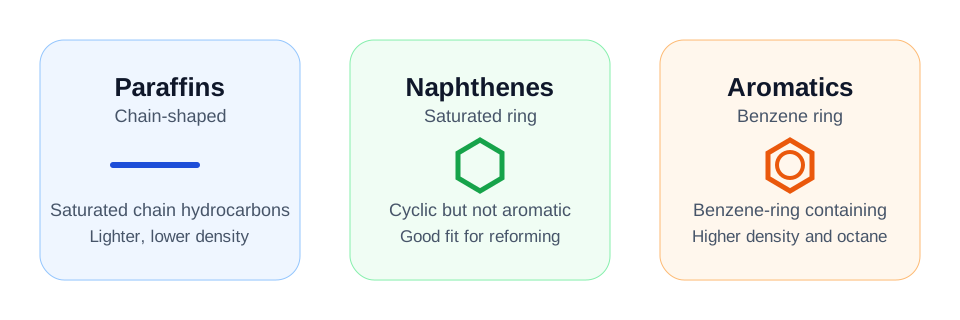
When you first try to read what is inside naphtha, set the individual molecular names aside and group everything into PNA — three bins. It is much easier to organise from there.
What matters is "chain? ring? benzene ring?"
Class
Rough shape
Typical examples
First thing to notice
Paraffins
Predominantly chain-shaped saturated hydrocarbons
Pentane, hexane
Easy to read as lighter / lower density
Naphthenes
Saturated hydrocarbons that are cyclic but not aromatic
Cyclohexane
Easy to see the connection to reforming
Aromatics
Molecules containing a benzene ring
Benzene, toluene, xylene
Density and octane tendency run higher
Note: "naphthene" here is a different word from the course title "naphtha." The relationship is simply that naphtha can contain naphthenes among its molecular families.
More carbons generally means heavier
As the carbon number grows, molecules generally get heavier, boiling points rise, and volatility drops.
Example
Rough reading
Pentane
Light, low boiling point, evaporates readily
Hexane
Still light, but a bit heavier than pentane
Toluene
Heavier, with visible aromatic character
Xylene
Heavier still, density tends to rise further
Rather than memorising exact numbers, lock in the direction first: "more carbons → heavier."
At the same cut, PNA still shifts properties
Even at a comparable cut range, more aromatics tends to pull density and octane tendency upward. More paraffins tends to read as lighter and lower-density.
Paraffin-heavy
Lighter and lower-density, fits the steam-cracking storyline.
Naphthene-heavy
Cyclic, with a clear link to reforming.
Aromatic-heavy
Density and octane tendency both run higher.
"Octane number" here just means how resistant a gasoline is to knocking. Knocking is the abnormal combustion that happens when fuel self-ignites earlier than the spark timing inside an engine — it can cause power loss and engine damage. The higher the octane number, the harder it is for knocking to occur. That is enough for this chapter.
Safety also has two axes
For safety, read both "light vs. heavy" and "which family dominates."
Axis
What tends to rise
Light side
Vapour pressure rises; fire risk and vapour handling need more attention.
Aromatic-heavy side
Exposure and regulatory topics tend to come up more.
This course only tracks trends, not numbers. For real-world safety judgements, always defer to the SDS.
Self-check
Six questions to firm up how you read PNA and carbon number.
Q 2-1 — The family of saturated cyclic hydrocarbons
Which molecular family primarily refers to saturated cyclic hydrocarbons?
Paraffins
Naphthenes
Aromatics
Show answer and reasoning
Answer: B
Naphthenes refer to "cyclic but not aromatic" saturated hydrocarbons, such as cyclohexane.
Q 2-2 — The benzene-ring family
Which family represents the benzene-ring-containing molecules?
Paraffins
Naphthenes
Aromatics
Show answer and reasoning
Answer: C
Benzene, toluene, and xylene are all aromatics.
Q 2-3 — Carbon number and boiling point
In general, what happens to the boiling point as the carbon number grows?
It tends to go up.
It tends to go down.
It is completely unrelated.
Show answer and reasoning
Answer: A
More carbons generally means heavier, which pushes the boiling point upward.
Q 2-4 — What "A" in PNA stands for
What does the A in PNA stand for?
Alkali
Aromatics
Aldehydes
Show answer and reasoning
Answer: B
PNA stands for Paraffins / Naphthenes / Aromatics.
Q 2-5 — Which side runs denser
At the same cut, which side tends to run denser?
A mixture with more aromatics.
A mixture with more paraffins.
It is always the same.
Show answer and reasoning
Answer: A
More aromatics usually reads heavier and raises density.
Q 2-6 — What rises on the light cut
In general, which tends to be higher on the light side of the cut?
Vapour pressure
Flash point
Viscosity
Show answer and reasoning
Answer: A
Lighter components evaporate more readily, so vapour pressure rises while flash point drops.
Chapter 2 summary
PNA is the three-way map you use to read naphtha at a first glance.
More carbons generally means higher boiling point and lower volatility.
Aromatics tend to push density and octane tendency up; the light side tends to push vapour pressure up.