Storage, transport, and delivery — 350/700 bar, liquefaction, carriers
Compare the three modes — high pressure, liquefaction, and carriers — by trading off volume, losses, equipment, and extra processing steps.
"How far" and "in what form" you move it
Hydrogen logistics does not stop at "moving hydrogen." On-vehicle storage, high-pressure tube trailers, pipelines, liquefied shipping, and carriers such as ammonia or MCH — the options shift with form and distance. There is no single right answer; the choice depends on scale, distance, demand pattern, and end use.
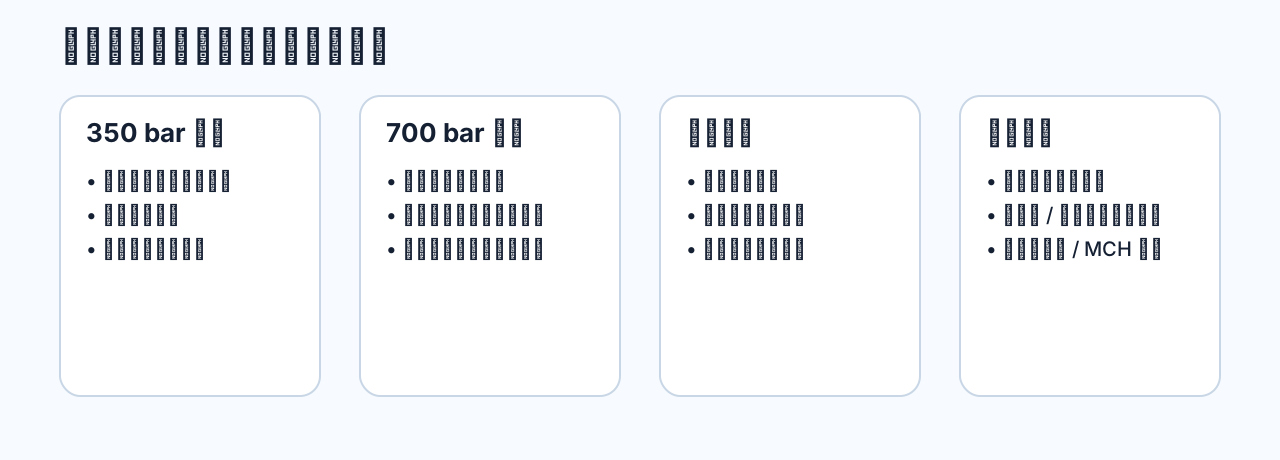
High pressure, liquefaction, and carriers are selected by trading off volume, losses, equipment, and recovery steps.
350 bar and 700 bar
When storing hydrogen as high-pressure gas, 350 bar and 700 bar are the two pressure classes that come up most often for on-board hydrogen tanks. The 700 bar side packs the same amount of hydrogen into a smaller volume, but it raises the requirements on compression energy, tanks, and piping. Put another way, the relationship is one where you improve volumetric efficiency at the cost of heavier equipment.
Liquids and carriers bring in a separate set of issues
Liquid hydrogen (LH2) is attractive on volume grounds, but cryogenic maintenance and boil-off become the dominant concerns. MCH (methylcyclohexane, chemical formula C₇H₁₄) is a liquid organic hydride that is liquid at ambient conditions; it can be viewed as toluene (C₇H₈) with three hydrogen molecules added. Because it can be handled at room temperature, the existing infrastructure for liquid fuels (tank trucks, tankers, storage tanks) is relatively easy to repurpose; on the other hand, releasing the hydrogen at the demand site requires a dehydrogenation reactor. Ammonia (NH₃) is also under consideration as a hydrogen carrier in the same way and is a candidate for long-distance transport. In all cases, a loading step and an unloading step are added, so losses, equipment, and reactors enter the picture as well.
Japan's hydrogen policy also considers multiple carriers — liquefied hydrogen, MCH, and ammonia. Rather than asking "which option is really hydrogen itself," it is easier to organize the picture by asking which extra steps are added.
Note: For the synthesis and use of ammonia itself, our separate course "The Haber–Bosch process and nitrogen fertilizers" (HB101) treats the conditions and equipment for the reaction N₂ + 3 H₂ → 2 NH₃ in detail. Here we treat ammonia as a vessel for transporting hydrogen, so refer to HB101 for the synthesis side.
Practice 1–3 — Basics of compression, liquefaction, and carriers
Check the basic trade-offs between high-pressure compression and liquefaction or carriers.
Q1. Comparing 350 bar and 700 bar, which is the closest direct advantage of the 700 bar side?
When pressure rises, think about what becomes easier first.
At 700 bar, the same amount of hydrogen fits into a smaller volume more easily. The trade-off is heavier compression and equipment requirements.
Q2. Which is the closest concern that specifically shows up when handling liquid hydrogen?
With liquid hydrogen, the fact that it is cold is itself a major issue.
For liquid hydrogen, cryogenic temperature management and boil-off are key design and operating concerns.
Q3. Which is the closest reason for using a hydrogen carrier such as ammonia or MCH?
Carriers are options chosen for ease of transport.
Hydrogen carriers become candidates for long-distance transport and large-scale supply, but in exchange you need additional conversion steps.
Practice 4–5 — Distance, scale, and extra steps
Check how to think about distance, scale, and extra process steps.
Q4. Which is the most appropriate way to think about choosing a hydrogen transport mode?
In this chapter we said that 'there is no single right answer.'
High pressure, liquid, carriers, and pipelines are picked depending on distance, scale, and shape of demand.
Q5. If you ultimately want to use pure hydrogen but transport it as a carrier, which step is most likely to be added on the demand side?
'Loading' and 'unloading' come as a pair.
When a carrier is used, a cracking or dehydrogenation step to release H₂ tends to be added at the demand site.
Key takeaways from Chapter 4
- High pressure (350/700 bar), liquefaction, and carriers are trade-offs among volume, losses, and equipment.
- 700 bar is favorable on volume, but compression energy and equipment requirements rise.
- Liquid hydrogen adds cryogenic temperatures and boil-off; carriers add loading and unloading steps.
- Transport modes are chosen based on distance, scale, demand pattern, and end use.