Properties and energy — light, but hard to store
Lock in the basic contrast — large per mass but small per volume — and connect it through to LHV / HHV and the storage-condition discussion.
There is only one contrast to remember first
The starting point for understanding hydrogen as a fuel is the contrast: energy per unit mass is large, but energy per unit volume at ambient conditions is small. That is why summarizing it as "a light, strong fuel" alone is misleading — "how to contain it" is always the next question.
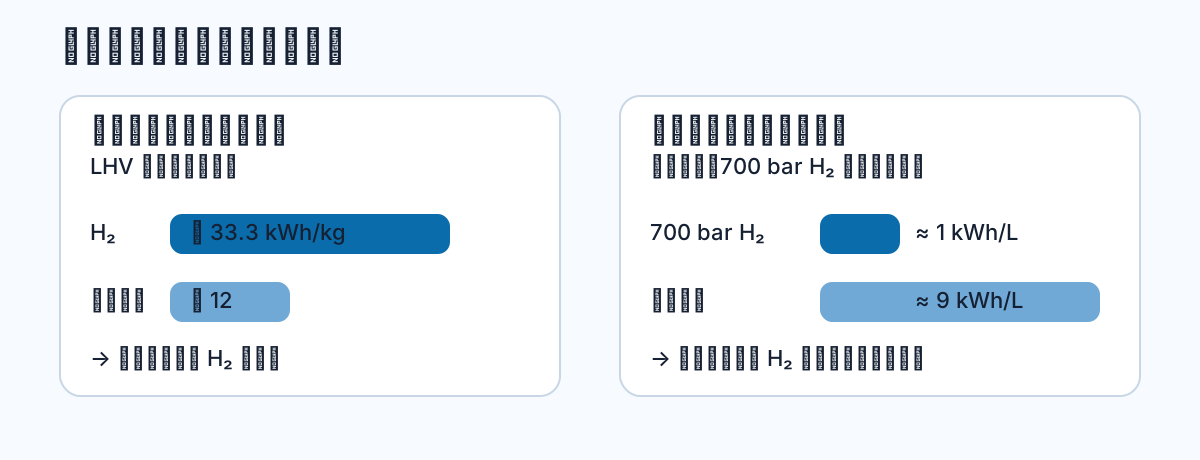
Hydrogen is favorable by mass but tends to be unfavorable by volume. That is why compression, liquefaction, and carrier conversion become important.
Do not mix up LHV and HHV
When discussing the energy content of hydrogen, it is important not to mix LHV (lower heating value) and HHV (higher heating value). The difference is whether you recover the heat of condensation of the water formed after the reaction. Discussions of vehicles and many energy systems typically use LHV, and the simple calculations in this course also proceed on an LHV basis.
The course uses the constant 1 kg of H₂ ≈ 33.3 kWh (LHV). This is a rounded form of the standard lower heating value of hydrogen (about 120 MJ/kg ≒ 33.33 kWh/kg), and similar values appear in DOE and AFDC reference materials. It is not a precise design value, but it is enough to grasp the relationship between mass and the energy that can be extracted.
How to compensate for the low density
At ambient temperature and pressure, hydrogen has very low density, so you need a large tank to hold it as-is. That is why high-pressure compression appears in vehicles, and liquefaction and carrier conversion appear in logistics. High pressure eases the volume problem, but increases compression energy and container strength requirements. Liquefaction is favorable by volume but brings in cryogenic temperatures and the issue of boil-off.
Boil-off refers to the gradual evaporation of cryogenic liquid (the boiling point of liquid hydrogen is about −253 °C) due to heat ingress from outside. Tank insulation is never perfect, so during long parking, mooring, or after a full fill, the internal pressure rises and the design vents a small amount through a relief valve. In other words, "the energy needed to keep it cold" and "the loss from evaporated hydrogen" come together as a single design issue.
Practice 1–3 — Mass and volume, and reading things on an LHV basis
Check the mass-vs-volume contrast and how to read things on an LHV basis.
Q1. Which contrast about hydrogen's properties does this course emphasize most?
Do not stop at 'light and strong' — pair it with 'hard to store'.
Hydrogen has a large energy per mass, but its energy per volume at ambient conditions is small, which is why storage method matters.
Q2. Which is closest to the main reason for wanting to compress or liquefy hydrogen?
Recall what you do to mitigate the low density.
Because hydrogen at ambient conditions takes up a lot of volume, compression, liquefaction, and carrier conversion improve storability.
Q3. Using the course constants, give the LHV-based energy content of 5 kg of H₂ in kWh.
Use 1 kg of H₂ ≈ 33.3 kWh (LHV).
5 × 33.3 = 166.5 kWh. The course uses this constant for rough estimates.
Practice 4–6 — LHV / HHV and storage conditions
Check the difference between LHV / HHV and how to read storage conditions.
Q4. Which is closest to the difference between HHV and LHV?
It was about how the water formed after the reaction is treated.
The difference between HHV and LHV is whether the heat of condensation of water is recovered.
Q5. Which is closest to a constraint that tends to be particularly tight for mobile platforms such as vehicles?
Look not only at 'how heavy it is' but also at 'how much space it takes'.
For mobile platforms, volume constraints — how much you can fit inside a limited chassis — matter in addition to weight.
Q6. Which is closest to a description of liquid hydrogen?
With liquid hydrogen, 'being cold' is itself the issue.
Liquid hydrogen has to be handled at cryogenic temperatures, and boil-off during storage also needs attention.
Chapter 2 summary
- Hydrogen is strong per mass but weak per volume at ambient conditions. That is the starting point.
- The course uses 1 kg of H₂ ≈ 33.3 kWh (LHV) to roughly estimate the mass-to-energy relationship.
- LHV and HHV differ in whether the heat of condensation of water formed after the reaction is counted. Do not mix them.
- For mobile platforms, volume constraints are tight; liquid hydrogen brings in the new issues of cryogenic temperatures and boil-off.