Process loop — compression, reaction, cooling, separation, recycle, and purge
Connect the equipment-level flow that the chemical equation alone cannot show, and see why the process is run as a loop instead of a single pass.
This page is readable without JavaScript, but the simulator and grading will not run.
0 / 4 correct. Results are saved only in this browser's localStorage.
Once you look at the loop, the reactor is only one part of it
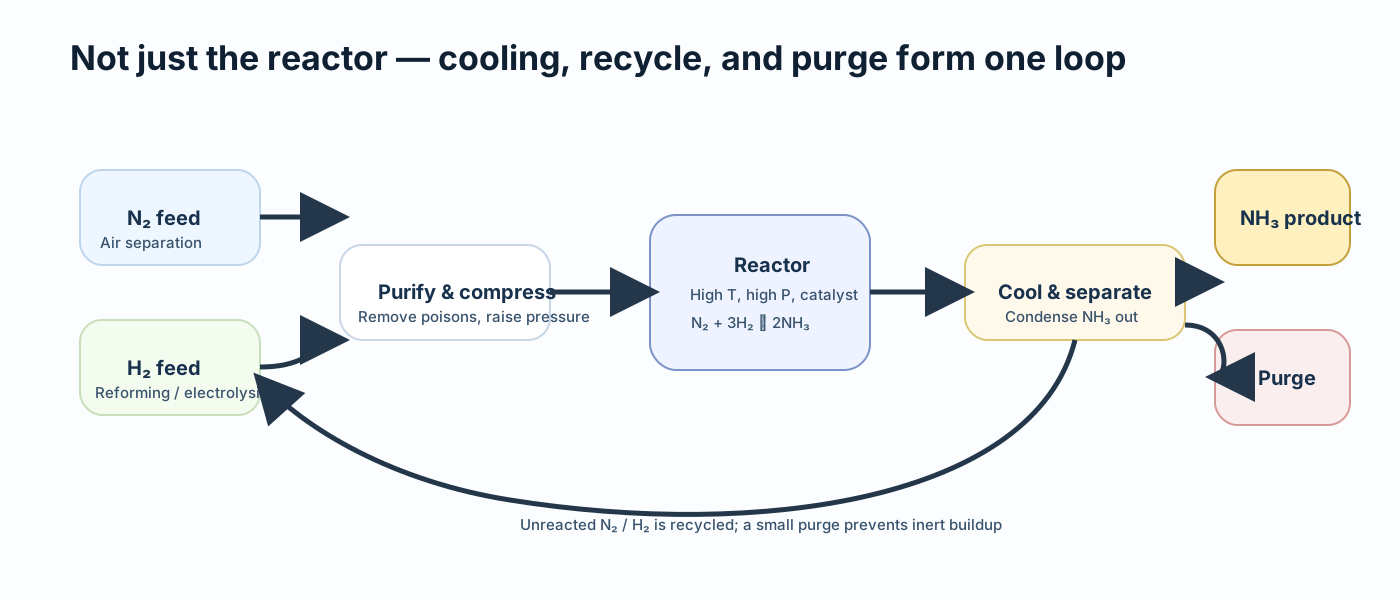
If you remember Haber–Bosch as "a single reactor," you miss about half of the point. In practice, feed conditioning, compression, reaction, cooling-based separation, recycle, and purge all move together as one synthesis loop.
Unreacted N₂ and H₂ are valuable gases, so we do not throw them away after one pass. That is why a recycle compressor sits after the separator.
Front end: putting N₂ and H₂ into a form the reactor will accept
N₂ is typically produced by air separation, and H₂ by steam methane reforming (SMR) or water electrolysis, among other routes. The key point is not just to make them, but to remove enough of the impurities the catalyst dislikes before feeding them in. The upstream purification from Chapter 4 connects here.
Comprehension check for this chapter
Practice 22–23
Check the roles of cooling-based separation and recycle.
Q22. Which best describes the main purpose of cooling the mixed gas after the reactor?
Q23. What is the main reason for recycling unreacted N₂ and H₂?
Why a purge is necessary
Recycle is crucial, but if the loop is fully closed, inert species such as argon and methane slowly build up in concentration. So, while keeping the loss of valuable H₂ to a minimum, we need to purge a small stream to keep the loop healthy. A typical purge rate is on the order of a few percent of the loop flow (often roughly in the 1–5% range), set by balancing the inert load against the acceptable H₂ loss.
Recycle alone lets inerts accumulate; purge alone loses too much feedstock. Balancing the two is at the heart of running the loop.
With green ammonia, what changes most is the front end
In green ammonia, the H₂ supply tilts toward water electrolysis powered by renewable electricity. That changes the carbon footprint of the front end significantly, but the downstream knowledge — reaction, separation, recycle, and purge — remains just as important.
Comprehension check for this chapter
Practice 24–25
Separate the roles of purge and of the green-ammonia front end.