Temperature, pressure, and equilibrium — low temperature and high pressure are favorable, but not enough on their own
Separate the direction Le Chatelier points to from the direction the reaction rate points to, and see why real plants settle on a compromise at high temperature and high pressure.
This page is readable without JavaScript, but the simulator and grading will not work.
0 / 5 correct. Your scores are saved only in this browser's localStorage.
Two different directions act on the equilibrium (Le Chatelier's principle)
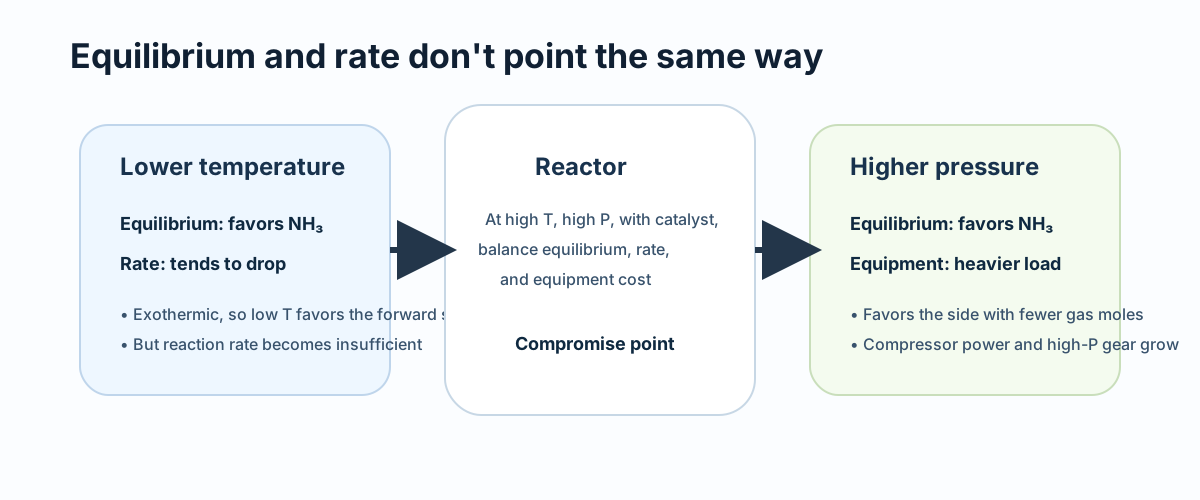
The familiar slogan "low temperature and high pressure are favorable" for the Haber–Bosch process is about the direction of the equilibrium. Forming ammonia is exothermic, and the number of gas moles also drops from 4 to 2. Both low temperature and high pressure therefore push the equilibrium toward the NH₃ side.
When an external condition (temperature, pressure, concentration, etc.) on a system at equilibrium is changed, the equilibrium shifts in the direction that counteracts the change. The statements "low temperature favors an exothermic reaction" and "high pressure favors the side with fewer gas moles" both follow from this principle covered in high-school chemistry.
That said, conditions that favor the equilibrium and conditions that actually deliver production volume in a real plant are different stories. Chapter 4 covers the rate side in detail; for now, just keep in mind that pushing too far toward low temperature drops the reaction rate, and pushing too far toward high pressure increases compression and equipment load. Real plant conditions are a compromise that reconciles both.
"Equilibrium is favorable" and "the reaction proceeds quickly" are separate questions (bridge to Chapter 4)
The main focus of this chapter remains the equilibrium side. Still, even if low temperature is favorable for the equilibrium, you will not get much production unless the rate of getting there is fast enough. A plant does not care about the theoretical maximum yield on its own — it cares about how much product you can actually make in a limited reactor volume within a limited time — and this "rate side" of the discussion is treated intensively in the next chapter (Chapter 4).
Question 1: in the end, which direction is favored? (= the theme of this chapter) Question 2: how quickly does the system approach it? (= the theme of Chapter 4) Chapter 3 focuses on the first; Chapter 4 mainly handles the second.
Check your understanding
Practice 12–14
Check high pressure, low temperature, and why low temperature alone is not enough.
Q12. What is the main reason that raising the pressure favors the NH₃ side?
Q13. Given that the forward reaction is exothermic, what tends to happen to the equilibrium direction when you lower the temperature?
Q14. Which of the following best describes the problem with lowering the temperature too far in a real plant?
Textbook conditions are a compromise, not the single "correct answer"
For an introductory view, it is enough to remember high pressure, around 400–500 °C, and an iron-based catalyst. Typical synthesis temperatures in real plants fall roughly in the 400–500 °C range (often around 420–480 °C), and pressures are typically around 150–300 bar (the classical high-pressure designs run around 200–350 bar). The exact window varies by technology, catalyst, and era, but the essential picture is the same: we want to move toward low temperature and high pressure, but the rate and equipment constraints pull back.
Why we do not simply push the pressure ever higher
High pressure is favorable for equilibrium, but it adds compression power, thicker-walled vessels, more demanding piping and seals, and larger safety margins. In other words, "higher is more favorable for the reaction" and "higher is more profitable overall" are not the same thing.
This intuition matters later, too, when thinking about green ammonia or smaller-scale distributed facilities. Looking only at the chemical equilibrium makes it easy to miss the engineering-side difficulties.
Check your understanding
Practice 15–16
Read the textbook conditions and the price paid for going to higher pressure.