Vertices — why the optimum lives at a corner
Slide the objective line in parallel and confirm the optimum, as well as alternate optima, by hand.
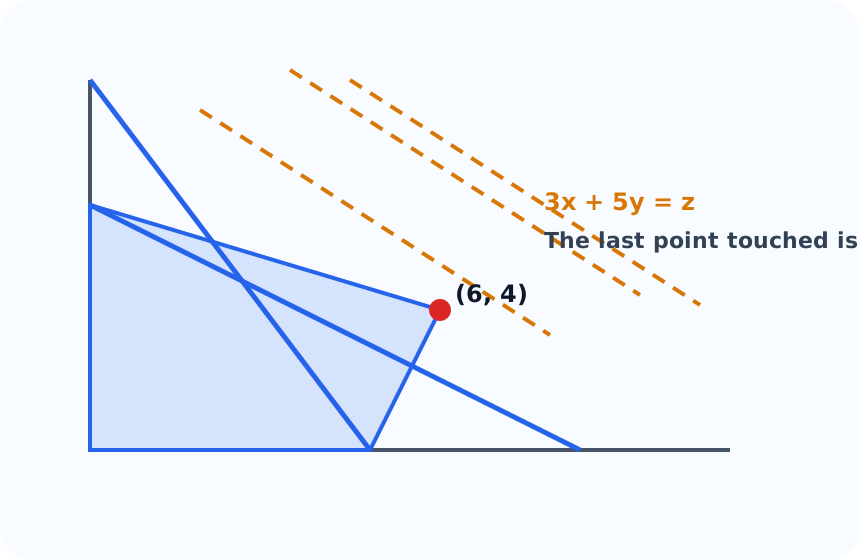
Read the objective function as a family of level lines
Fixing a value of the objective function z = 3x + 5y gives a straight line 3x + 5y = constant. As the constant grows, the line is pushed to the upper right without changing direction.
Push it out as far as possible without leaving the feasible region, and the last point of contact is the optimum.
The slope of the objective line is -c_x / c_y. When the coefficient ratio changes, so does the direction you push.
Why the contact happens at a vertex: the objective function is linear (a straight line) and the feasible region is a convex polygon bounded by straight edges. When you slide a straight line in parallel and check where it last touches a convex polygon, the contact almost always occurs at a corner (a vertex). The only exception is when the objective line happens to be parallel to one of the polygon's edges — then the entire edge touches at the same time, giving multiple optimal solutions.
In the standard case, just score the vertices
Combining the intersection (6, 4) already computed in Chapter 3 with the axis intercepts, the main vertices of the feasible region are these four (we do not redo the intersection calculation here).
| Vertex | Meaning |
|---|---|
(0, 0) | Produce nothing |
(8, 0) | Fill the cutting step entirely with A |
(6, 4) | The intersection where both process constraints bind at once (computed in Chapter 3) |
(0, 7) | Fill the finishing step entirely with B |
For a two-variable introduction, the most transparent approach is to evaluate the objective at these vertices and compare directly.
Hands-on 1
Score the main vertices yourself and identify the optimum from the numbers.
Score vertex (8, 0)
With objective z = 3x + 5y, compute the objective value at the vertex (8, 0).
Show hint
3×8 + 5×0 = 24. Apply the same formula to each candidate vertex.
Score vertex (6, 4)
Compute the objective value at the intersection (6, 4).
Show hint
3×6 + 5×4 = 18 + 20 = 38.
Score vertex (0, 7)
Compute the objective value at the vertex (0, 7).
Show hint
3×0 + 5×7 = 35. In the standard case, (6, 4) turns out to be larger.
Pick the optimum of the standard case
For the standard case maximize z = 3x + 5y, enter the coordinates of the optimal vertex.
Show hint
The main vertices give (8,0)→24, (6,4)→38, (0,7)→35, so the optimum is (6,4).
Alternate optima happen when lines are parallel
When the slope of the objective line matches a side of the feasible region exactly, the same objective value is attained not at a single vertex but along an entire edge.
2x + y = z is parallel to 2x + y = 16x + 2y = z is parallel to x + 2y = 14In that case the question is no longer "which vertex is optimal" but "which edge is optimal".
Multiple optima mean that any point on the edge yields the same profit (objective value). For example, "we can shift production from product A to product B and still earn the same total profit." Since the math alone cannot rank these points, management can pick freely based on criteria not written into the objective function — production-line stability, inventory risk, delivery deadlines, customer relationships, and so on. Read alternate optima not as "we cannot decide" but as "we have flexibility".
Hands-on 2
Work through the smallest example of alternate optima and contrast it with a single-vertex optimum.
Spot the alternate optima
Change the objective to maximize z = 2x + y. The optimum is no longer a single point but an entire edge. Enter the optimal value and choose the type of the optimum.
Show hint
The objective 2x + y is parallel to the constraint 2x + y ≤ 16. So the whole segment of that constraint edge inside the feasible region attains z = 16.
Key takeaways from this chapter
- In a 2-variable LP, scoring the vertices of the feasible region is the quickest way to locate the optimum.
- In the standard case, the optimum is
(6, 4)with objective value 38. - When the objective becomes parallel to a constraint edge, alternate optima appear.