Introduction — why thresholds alone cause trouble
Before we step into fuzzy control, let's see with numbers how large a step threshold control produces at a boundary.
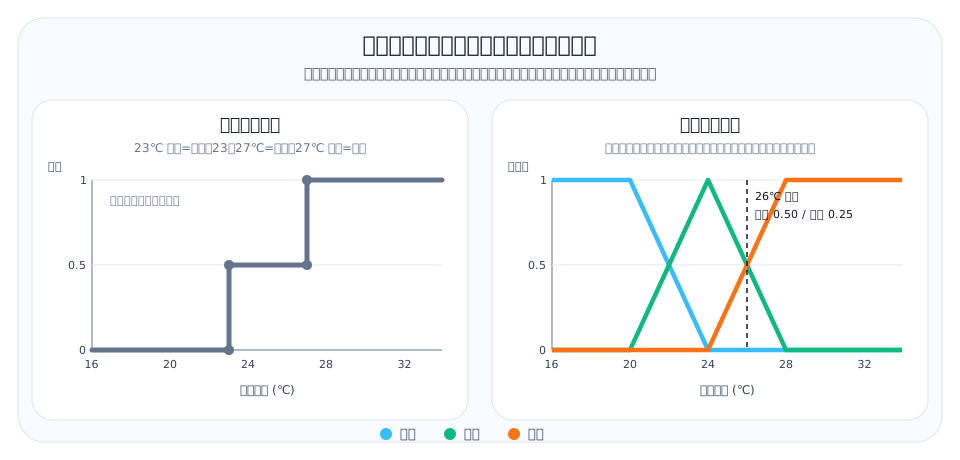
Even when the sensor reading wobbles just a little near the boundary, threshold control tends to switch abruptly, while fuzzy control can change smoothly by the amount of overlap.
Start by thinking of a fan with three speed levels
Throughout this course we work with a small controller that decides fan output from temperature and humidity. As a point of comparison, we first set up the following threshold controller.
| Condition | Output | Value |
|---|---|---|
| Temperature < 23°C | Low | 20 |
| 23°C ≤ Temperature < 27°C and Humidity < 45% | Low | 20 |
| 23°C ≤ Temperature < 27°C and 45% ≤ Humidity < 70% | Medium | 50 |
| 23°C ≤ Temperature < 27°C and Humidity ≥ 70% | Medium | 50 |
| Temperature ≥ 27°C and Humidity < 45% | Medium | 50 |
| Temperature ≥ 27°C and Humidity ≥ 45% | High | 85 |
This table is for comparison only. From Chapter 2 onward we replace it with "labels that overlap with each other."
The problem is the jump "right at the boundary"
For example, keep humidity fixed at 69% and let the temperature go from 26.8°C to 27.1°C. To a human the sensation is at most "it got a little warmer," but the threshold controller jumps Medium 50 → High 85 the instant it crosses 27°C.
Check 1 — Trace the threshold jump by hand
Answer using only the threshold rules from this chapter. Outputs are low = 20, medium = 50, high = 85.
Q1. With a room temperature of 22.5°C and humidity of 40%, what is the threshold controller's output?
22.5°C is below 23°C, so it is on the 'cold' side. Regardless of humidity, the output is low = 20.
Q2. With a room temperature of 26.8°C and humidity of 69%, what is the threshold controller's output?
26.8°C is below 27°C, so it is 'comfortable', and 69% is below 70%, so it is 'normal'. Therefore the output is medium = 50.
Q3. With a room temperature of 27.1°C and humidity of 69%, what is the threshold controller's output?
27.1°C switches to the 'hot' side. Humidity 69% is 'normal', so the output is high = 85.
Q4. What is the output difference between the previous two questions, in points?
The output jumps from 50 to 85, so the difference is 35 points. The jump at the boundary is now visible as a number.
The intuition to take away from this chapter
The starting point of fuzzy control is not "erase ambiguity rigorously" — it is to avoid carrying steps straight into the controller. From Chapter 2 we look at how, instead of removing the boundaries, we let labels overlap slightly and handle them as numbers between 0 and 1.
For reference: the temperature boundaries 23°C and 27°C used in the threshold table above correspond roughly to the overlap regions (19–25°C and 25–29°C) of the temperature membership functions "cold / comfortable / hot" introduced in Chapter 2. The humidity boundaries 45% and 70% are likewise replaced by the overlap regions of the humidity labels "dry / normal / humid."